arXiv 2510.25741 · open weights on Hugging Face

Scaling Latent Reasoning via Looped Language Models

Ouro is a family of pre-trained Looped Language Models that reason by iterating a shared stack of layers in latent space. Trained on 7.7T tokens, the 1.4B and 2.6B models match dense LLMs of up to 12B parameters.

Show all 33 authors
Rui-Jie Zhu*, Zixuan Wang*, Kai Hua*, Tianyu Zhang*, Ziniu Li*, Haoran Que*, Boyi Wei*, Zixin Wen*, Fan Yin*, He Xing*, Lu Li, Jiajun Shi, Kaijing Ma, Shanda Li, Taylor Kergan, Andrew Smith, Xingwei Qu, Mude Hui, Bohong Wu, Qiyang Min, Hongzhi Huang, Xun Zhou, Wei Ye, Jiaheng Liu, Jian Yang, Yunfeng Shi, Chenghua Lin, Enduo Zhao, Tianle Cai, Ge Zhang*†, Wenhao Huang†, Yoshua Bengio, Jason Eshraghian†
* Core contributors  ·  † Corresponding authors
LoopLM forward passR = 4 recurrent steps
Exit gatep(exit at step t) LM headloss at every step shared weights Layer N ⋮ Layer 2 Layer 1 Input embedding ×R
7.7T
pre-training tokens
2–3×
parameter efficiency vs. standard Transformers
≤12B
dense SOTA models matched by 1.4B / 2.6B Ouro
158 papers
cite Ouro — see follow-up research →

Updates

News

2026-10

158 papers now cite Ouro. We curated 35 follow-ups that substantively extend looped LMs — 15 of them run directly on the Ouro checkpoints.

2026-07-25

Ouro was removed from vLLM main (#49786). vLLM v0.26.0 is the last release with native Ouro support — pin it to keep serving Ouro.

2025-11-18

vLLM v0.11.1 ships the first release with native OuroForCausalLM support.

2025-10-30

Ouro support merged into vLLM (#27794).

2025-10-29

Paper released on arXiv; Ouro-1.4B / 2.6B and their Thinking variants released on Hugging Face.

Fast inference

Serve Ouro with vLLM

Last version with Ouro support
vllm==0.26.0

Native Ouro support shipped in v0.11.1 and was removed after v0.26.0; newer versions refuse to load Ouro. Pin v0.26.0 to keep serving it.

v0.11.1Nov 2025 · added v0.26.0 ✓Jul 2026 · last v0.27.0+removed
  • Pass --trust-remote-code.
  • vLLM always runs all 4 loops (no adaptive early exit).
1 · Install
$ pip install "vllm==0.26.0"
2 · Serve (OpenAI-compatible API)
$ vllm serve ByteDance/Ouro-2.6B-Thinking \
    --trust-remote-code
or · Docker
$ docker run --gpus all --ipc=host -p 8000:8000 \
    -v ~/.cache/huggingface:/root/.cache/huggingface \
    vllm/vllm-openai:v0.26.0 \
    --model ByteDance/Ouro-2.6B-Thinking --trust-remote-code
3 · Offline inference (Python)
from vllm import LLM, SamplingParams

llm = LLM(model="ByteDance/Ouro-2.6B-Thinking",
          trust_remote_code=True)
params = SamplingParams(temperature=1.0, top_p=0.7,
                        max_tokens=4096)
messages = [{"role": "user",
             "content": "If 2x + 3 = 11, what is x?"}]
out = llm.chat(messages, params)
print(out[0].outputs[0].text)

Overview

Introducing Ouro

Instead of leaving reasoning to chain-of-thought after training, Ouro builds it into pre-training: iterative computation in latent space, an entropy-regularized objective that learns how deep to think, and 7.7T tokens of data.

Its gains come from better knowledge manipulation, not more knowledge storage, and its latent reasoning is more faithful than explicit chain-of-thought.

Looped architecture

One shared stack, applied R = 4 times.

Learned depth allocation

Easy tokens exit early; hard tokens loop longer.

Knowledge manipulation

Better at composing facts, not storing more.

Faithful latent reasoning

Latent steps track the final answer closely.

Results

Performance

Competitive with dense models 2–3× larger.

Base models

vs. dense base models up to 3× larger.

Ouro-1.4BQwen3-1.7BGemma3-4BQwen3-4B
Ouro-2.6BQwen3-4BQwen3-8BGemma3-12B
MMLU0–100
Ouro-1.4B67.3
Qwen3-1.7B62.5
Gemma3-4B58.4
Qwen3-4B73.2
Ouro-2.6B74.6
Qwen3-4B73.2
Qwen3-8B76.6
Gemma3-12B72.1
MMLU-Pro0–100
Ouro-1.4B48.6
Qwen3-1.7B37.3
Gemma3-4B34.6
Qwen3-4B51.4
Ouro-2.6B55.7
Qwen3-4B51.4
Qwen3-8B53.7
Gemma3-12B49.2
BBH0–100
Ouro-1.4B71.0
Qwen3-1.7B53.5
Gemma3-4B66.3
Qwen3-4B71.0
Ouro-2.6B80.5
Qwen3-4B71.1
Qwen3-8B77.7
Gemma3-12B78.4
GSM8K0–100
Ouro-1.4B78.9
Qwen3-1.7B70.3
Gemma3-4B68.7
Qwen3-4B72.9
Ouro-2.6B81.6
Qwen3-4B72.9
Qwen3-8B83.1
Gemma3-12B77.2
MATH5000–100
Ouro-1.4B82.4
Qwen3-1.7B25.8
Gemma3-4B68.6
Qwen3-4B59.6
Ouro-2.6B90.8
Qwen3-4B59.6
Qwen3-8B62.3
Gemma3-12B83.2
HumanEval+0–100
Ouro-1.4B67.4
Qwen3-1.7B59.8
Gemma3-4B29.3
Qwen3-4B70.7
Ouro-2.6B70.7
Qwen3-4B70.7
Qwen3-8B75.3
Gemma3-12B37.2
All 12 benchmarks
Ouro-1.4B vs. 1.7–4B dense models
Ouro-1.4BQwen3-1.7BGemma3-4BQwen3-4B
MMLU67.3562.4658.3773.19
MMLU-Pro48.6237.2734.6151.40
BBH71.0253.5166.3270.95
ARC-C60.9255.7260.9263.65
HellaSwag74.2967.0975.5875.66
Winogrande72.3066.3071.0771.19
GSM8K78.9270.2868.6972.86
MATH50082.4025.8068.6059.60
HumanEval74.4066.5034.8077.40
HumanEval+67.4059.8029.3070.70
MBPP73.0068.0060.6078.80
MBPP+62.7058.5051.1065.90
Ouro-2.6B vs. 4–12B dense models
Ouro-2.6BQwen3-4BQwen3-8BGemma3-12B
MMLU74.6073.1976.6372.14
MMLU-Pro55.7351.4053.7249.21
BBH80.4671.1477.6578.41
ARC-C66.4063.6566.1072.44
HellaSwag79.6975.6679.6083.68
Winogrande75.8571.1976.8077.74
GSM8K81.5872.8683.0977.18
MATH50090.8559.6062.3083.20
HumanEval78.7077.7084.8046.30
HumanEval+70.7070.7075.3037.20
MBPP80.4078.8079.0073.50
MBPP+66.6065.9067.9066.10

Thinking models

pass@1 · DeepSeek = R1-Distill-Qwen.

Ouro-1.4BDeepSeek-1.5BQwen3-1.7BQwen3-4B
Ouro-2.6BQwen3-4BDeepSeek-7BQwen3-8B
AIME240–100
Ouro-1.4B65.0
DeepSeek-1.5B29.6
Qwen3-1.7B32.0
Qwen3-4B61.3
Ouro-2.6B64.7
Qwen3-4B61.3
DeepSeek-7B57.3
Qwen3-8B73.0
AIME250–100
Ouro-1.4B46.3
DeepSeek-1.5B23.0
Qwen3-1.7B22.0
Qwen3-4B51.3
Ouro-2.6B50.3
Qwen3-4B51.3
DeepSeek-7B36.0
Qwen3-8B66.7
OlympiadBench0–100
Ouro-1.4B71.5
DeepSeek-1.5B56.4
Qwen3-1.7B56.4
Qwen3-4B73.2
Ouro-2.6B76.4
Qwen3-4B73.2
DeepSeek-7B72.0
Qwen3-8B75.2
BeyondAIME0–100
Ouro-1.4B34.0
DeepSeek-1.5B9.00
Qwen3-1.7B15.0
Qwen3-4B31.0
Ouro-2.6B39.0
Qwen3-4B31.0
DeepSeek-7B30.0
Qwen3-8B38.0
GPQA0–100
Ouro-1.4B45.5
DeepSeek-1.5B33.2
Qwen3-1.7B34.0
Qwen3-4B54.5
Ouro-2.6B52.7
Qwen3-4B54.5
DeepSeek-7B51.0
Qwen3-8B59.1
SuperGPQA0–100
Ouro-1.4B47.4
DeepSeek-1.5B26.5
Qwen3-1.7B35.9
Qwen3-4B51.9
Ouro-2.6B53.7
Qwen3-4B51.9
DeepSeek-7B46.6
Qwen3-8B48.0
All 7 benchmarks
Reasoning benchmarks (pass@1)
Ouro-1.4B-ThinkingOuro-2.6B-ThinkingQwen3-1.7BQwen3-4BQwen3-8BDeepSeek-1.5BDeepSeek-7B
AIME2465.0064.7032.0061.3073.0029.6057.30
AIME2546.3050.3022.0051.3066.7023.0036.00
OlympiadBench71.5576.4456.4473.1875.2556.4472.00
BeyondAIME34.0039.0015.0031.0038.009.0030.00
HLE5.215.584.135.212.224.225.14
SuperGPQA47.3753.6835.9251.8948.0026.5046.60
GPQA45.4552.6934.0054.5459.1033.1651.01

Performance by recurrent depth

Average of 6 benchmarks. Trained with T = 4: quality peaks there and drops only slightly beyond.

Trained depths (T ≤ 4)Extrapolation (T > 4)
020406080
49.9
72.4
69.9
T=1T=2T=3T=4T=5T=6T=7T=8
020406080
60.0
77.4
76.4
T=1T=2T=3T=4T=5T=6T=7T=8
View data table
Ouro-1.4B by recurrent step
ARC-CARC-ECommonsenseQAHellaSwagMMLUWinograndeAverage
T=137.6363.8544.6455.2441.2156.9949.93
T=254.8680.3067.9871.1560.4366.6966.90
T=359.4783.3374.3774.0766.7171.3571.55
T=460.9283.9675.4374.2967.4572.3072.39
T=5 (extrapolated)58.9682.9175.3573.7266.6470.3271.32
T=6 (extrapolated)59.7382.5874.9472.7765.7771.0371.14
T=7 (extrapolated)58.9681.9974.2872.3565.2870.0970.49
T=8 (extrapolated)58.1982.0773.5571.6064.4969.3069.87
Ouro-2.6B by recurrent step
ARC-CARC-ECommonsenseQAHellaSwagMMLUWinograndeAverage
T=147.9572.3957.5868.9451.5561.4859.98
T=262.3785.2376.9077.6167.6370.4873.37
T=365.3687.3379.7779.1273.5774.3576.58
T=466.3886.9581.6579.5674.6075.5377.44
T=5 (extrapolated)65.3686.8381.2479.5774.4375.9377.23
T=6 (extrapolated)65.0286.7481.0879.6373.7975.3776.94
T=7 (extrapolated)65.4486.5780.7579.5972.9275.7776.84
T=8 (extrapolated)64.7686.4981.0879.5072.2474.5976.44

Strategy

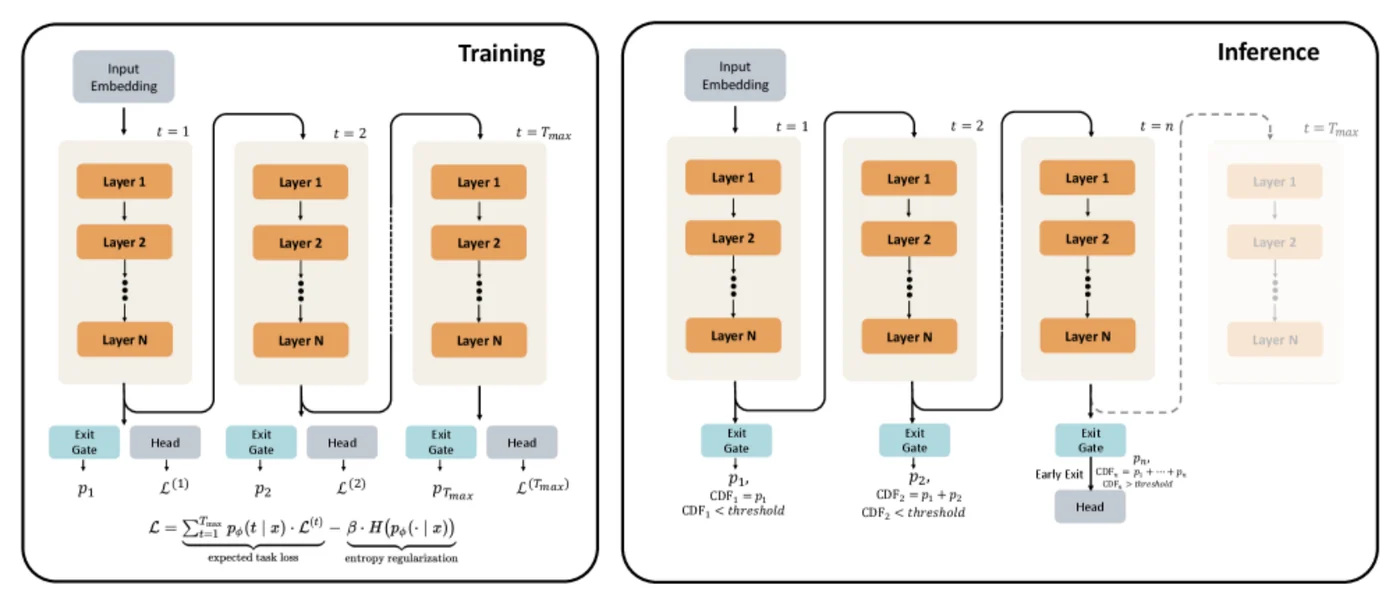
How a LoopLM decides how deep to think

  1. 01

    Train every depth

    Every loop gets an LM loss, weighted by a learned exit distribution with a uniform-prior entropy term.

  2. 02

    Teach the exit gate

    A second stage trains only the gate: continue while the next loop still lowers the loss.

  3. 03

    Exit with Q-exit

    Stop once the cumulative exit probability reaches q, a deploy-time compute knob.

Training: every recurrent step has an exit gate and LM head; the loss is the exit-probability-weighted task loss minus beta times the entropy of the exit distribution. Inference: the model exits once the cumulative exit probability passes a threshold.
Training with an entropy-regularized objective (left) and threshold-based early exit at inference (right).

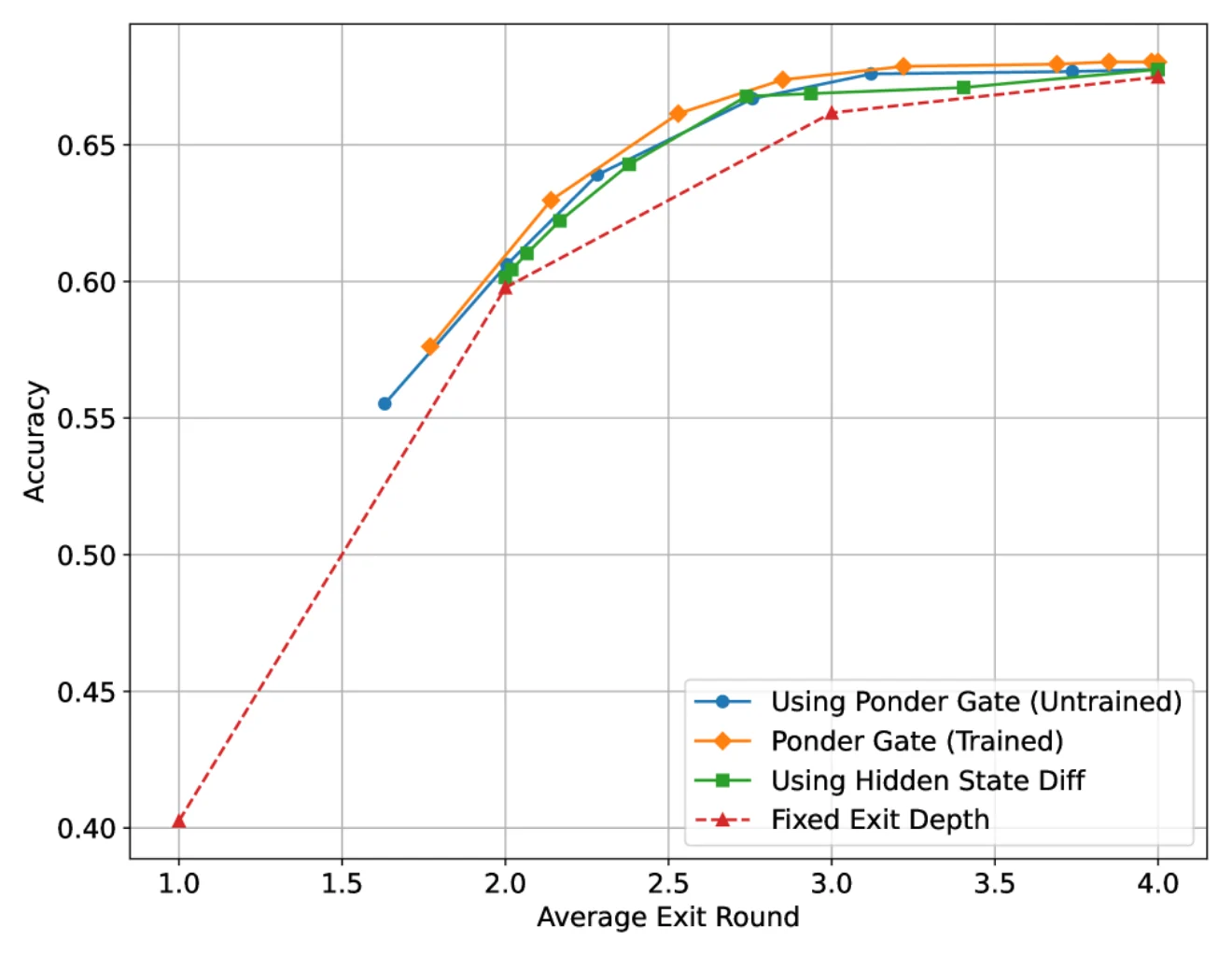
Early-exit strategies

Line chart of MMLU accuracy versus average exit round for four strategies: trained ponder gate, untrained ponder gate, hidden-state difference threshold, and fixed exit depth. The trained gate is highest at every budget.
  • The trained gate is best at every budget (~66% MMLU at 2.5 loops).
  • Fixed depth: 1 loop ≈ 40%, 4 loops 67.35%.

KV cache sharing

When decoding, keeping only the last loop's cache matches the full cache at ¼ the memory.

GSM8KOuro-1.4B
Full cache78.9
Last-step only78.8
Averaged78.7
First-step only18.7
MATH-500Ouro-1.4B
Full cache82.4
Last-step only80.4
Averaged78.5
First-step only8.43
Full cache (1× memory)Last-step only (¼)Averaged (¼)First-step only (¼)
View data table
KV cache sharing during decoding (Ouro-1.4B)
GSM8KMATH-500KV memory
Full cache78.9282.401×
Last-step only78.8580.40¼
Averaged78.7378.52¼
First-step only18.738.43¼

Open weights

Models

Four Apache-2.0 checkpoints: two base models and two reasoning (Thinking) models.

Code: rkstgr/LoopLM (open-source training reimplementation). Inference: modeling_ouro.py with trust_remote_code=True; also MLX, chatllm.cpp, OpenVINO and TransformerLens.

Recipe

Training pipeline

7.7T tokens in total; the 2.6B model is upcycled from the shared 3T-token checkpoint.

Stable 1 · 3T
Stable 2 · 3T
CT anneal · 1.4T
Stable training 1 — 3T Stable training 2 — 3T CT annealing — 1.4T LongCT — 20B Mid-training — 300B
  1. Warmup

    Common warmup for both model sizes.

  2. 3T
    Stable training I

    Shared pre-training phase at 4K sequence length.

  3. Model branching

    Keep the 1.4B model; upcycle a 2.6B model by duplicating layers.

  4. 3T
    Stable training II

    Both sizes continue with 4 recurrent steps for stability.

  5. 1.4T
    CT annealing

    Continual training on higher-quality math & code data, 16K sequences.

  6. 20B
    LongCT

    Long-context training on ProLong at 64K tokens.

  7. 300B
    Mid-training

    Advanced capability refinement at 32K tokens.

  8. Reasoning SFT

    ~8.3M examples yield the Thinking models.

Decoder-only Transformer with RoPE, SwiGLU and sandwich RMSNorm.

Community

Research building on Ouro

Follow-ups that substantively extend looped LMs, grouped by theme.

158citing papers
35featured follow-ups
15run on Ouro checkpoints

Reasoning, RL & decoding

7 featured

Post-training, reinforcement learning and decoding methods that make looped models reason better.

RLTTRuns on Ouro

Prioritize the Process, Not Just the Outcome: Rewarding Latent Thought Trajectories Improves Reasoning in Looped Language Models

Jonathan Williams and Esin Tureci · Feb 2026

GRPO only credits the final latent state of a looped model. RLTT spreads reward across the whole latent thought trajectory as a drop-in replacement for GRPO with negligible overhead. On Ouro-1.4B/2.6B-Thinking it lifts mean accuracy on MATH-500, AIME24/26 and BeyondAIME by +5.8% and +10.9%, and transfers beyond math.

Loop DropoutRuns on Ouro

Loop Dropout: Regularizing Shared Updates in Looped Language Models

Zirui Zhu et al. · Sep 2026

Standard LoRA on a looped model mostly adapts the late loops. Loop Dropout randomly skips the shared adapter at some loops during training, with inverse-survival rescaling, yielding stronger early-loop adaptation and better math, instruction-following and code results on Ouro — still plain LoRA at inference.

TaH2Ouro-style baseline

Improving Test-Time Scaling with Adaptive Looped Transformers

Yichen You et al. · Sep 2026

Post-trains Ouro- and Huginn-style looping on Qwen3 and finds many tokens gain nothing from extra iterations. TaH2 learns which tokens to iterate via lookahead depth supervision, improving the AIME accuracy–compute slope by 53% over the non-looped baseline, with gains that keep growing up to depth 8.

LatentMTRuns on Ouro

LatentMT: Machine Translation with Latent Reasoning

Wei-Rui Chen et al. · Jul 2026

The first systematic study of latent-reasoning looped models for machine translation. A lightweight adaptation of Ouro-2.6B-Thinking matches models 3–5× larger across 32 directions and reaches state of the art on mid- and low-resource languages.

Tool callingRuns on Ouro

Looped Language Models Improve Compositional Tool Calling

Andrei Cristian Popescu et al. · Aug 2026

Evaluates Ouro and retrofitted looped models on API-Bank, BFCL and NESTful under matched SFT. Extra recurrence helps most on compositional, dependency-aware multi-call tool use, and adaptive depth gives the best compute–accuracy trade-off.

Efficient inference & deployment

9 featured

KV-cache compression, speculative decoding, batching and quantization that turn parameter efficiency into real-world speed.

FlashLoopRuns on Ouro

FlashLoop: Fast and Memory-Efficient Looped Transformers via Lazy Updates

Wanqi Yang and Shiwei Liu · Sep 2026

Cross-loop computation is highly redundant: updates concentrate on few tokens, attention changes on a sparse set of keys, and inter-loop KV residuals quantize well. Training-free FlashLoop exploits all three for lossless accuracy with up to 1.64× speedup and 6× smaller KV cache on the Ouro family.

HLARuns on Ouro

Hybrid Latent Attention for Looped Language Models

Yuhan Chen et al. · Oct 2026

Keeps exact KV only for a sliding window and stores older tokens as compact latents that every loop queries directly. Uptrained on frozen Ouro-1.4B/2.6B, the cache shrinks 10.7×, batch capacity grows 4–8.8× and decoding speeds up 2.5–7.4× while retaining >97% of accuracy.

Dynamic depthRuns on Ouro

Enabling Dynamic Computation in Looped LMs

Aayush Mishra et al. · Oct 2026

Explains why early exit saves little in practice (every depth needs its own KV) and proposes a “best-available” KV cache that works out of the box, cutting FLOPs and KV memory by up to 30% at full-depth quality, plus a fix to the exit prior so tokens exit at genuinely different depths.

LLARuns on Ouro

Looped Latent Attention: Cross-Loop KV Compression for Looped Transformers

James O' Neill and Fergal Reid · Jul 2026

The loop-indexed KV cache traces short low-rank trajectories that converge across loops. Looped Latent Attention stores compact K/V latents instead; on one H200 it raises Ouro-1.4B batch capacity at 4K context from 32 to 768 sequences at 21.3× compression.

LoopSpecRuns on Ouro

LoopSpec: Pipelined Self-Speculative Decoding for Looped Transformers

SangLyul Cho et al. · Sep 2026

Pipelined self-speculative decoding that drafts from early recurrent states while verifying the current token, with a selective second proposal from a deeper loop and closed-form optimal draft depths. Lossless, and up to 6.83× faster across Ouro and other looped models.

Depth batchingRuns on Ouro

Depth-adaptive Inference of Looped Language Models via Continuous Depth Batching

Kristian Schwethelm et al. · Aug 2026

Depth-adaptive inference breaks standard batching because tokens exit at different loops. Continuous depth batching re-forms batches between loop steps and predicts exits ahead of time, realizing up to 99% of the attainable speedup on Ouro-1.4B — fully looped designs like Ouro suit it best.

LoopyRuns on Ouro

Loopy: Low-Bit Quantization Framework for Looped Language Models

Zeyu LI et al. · Oct 2026

Quantization error in a shared core compounds across loops, and the best PTQ configuration changes with depth. Loopy selects scaling/rotation configurations by loss at the deployment depth; under W4A4 on Ouro-1.4B it cuts LAMBADA perplexity by 36.5% versus SpinQuant.

Architecture, stability & scaling laws

7 featured

New looped architectures, stabilization techniques and scaling laws for recurrent depth.

Parcae

Parcae: Scaling Laws For Stable Looped Language Models

Hayden Prairie et al. · Apr 2026

Recasts looping as a dynamical system over the residual stream and traces instability to large spectral norms in the injection parameters. Constraining them lowers perplexity by up to 6.3% over prior large-scale looped models and yields power laws for scaling loops together with data.

Looped-MoE

Sparse Layers are Critical to Scaling Looped Language Models

Ryan Lee et al. · May 2026

Dense looped models scale worse than standard Transformers, but Looped-MoE models scale better: different experts fire on each pass through the shared layers. Loop boundaries also make superior early-exit points, pointing to Looped-MoE + early exit as a scaling recipe.

Attractor Models

Solve the Loop: Attractor Models for Language and Reasoning

Jacob Fein-Ashley and Paria Rashidinejad · May 2026

A backbone proposes output embeddings and an attractor module solves for their fixed point with implicit differentiation, so training memory is constant in depth. A 770M model beats a 1.3B Transformer trained on twice the tokens; a 27M model solves 91.4% of Sudoku-Extreme.

Shared memory (LPT)Builds on Ouro's looping

The Surprising Effectiveness of Shared Memory in Looped Transformers

Giovanni Monea et al. · Oct 2026

Pretrains looped models in which only the first recursion writes a KV cache and later recursions read it. Sharing memory improves quality: the hybrid lowers FineWeb-Edu perplexity by 1.1–1.8 versus a same-size Transformer with 76–79% less context memory.

Hyperloop

Hyperloop Transformers

Abbas Zeitoun et al. · Apr 2026

Loops only a middle block and adds hyper-connections (matrix-valued residual streams) after each loop. Matches depth-matched Transformer and mHC baselines with ~50% fewer parameters, and the advantage survives weight quantization.

Looped models at scale

3 featured

Larger and production-grade models that adopt looping as a core design choice.

Nanbeige4.2-3B

Nanbeige4.2-3B: Unlocking Agentic Capabilities in a Compact Model

Nanbeige Lab et al. · Jul 2026

A production-grade looped model: 3B non-embedding parameters pretrained from scratch on 28T tokens with a Looped Transformer, then agentic SFT and RL. It outperforms larger models such as Qwen3.5-9B and Gemma4-12B on agentic benchmarks.

Loopie

Loop the Loopies!

Zitian Gao et al. · Jul 2026

Two looped MoE models (20B-A2B and 6B-A0.6B) that close the long-standing gap where scaling parameters beats looping. In compute-matched ablations, including against a vanilla 30B-A3B model, Loopie clearly outperforms Transformer baselines.

SMELT

SMELT: Scaling Laws for Compute-Matched MoE Looped Transformers

Shaowen Wang et al. · Sep 2026

Loops the middle half of an MoE Transformer twice while matching FLOPs, parameters and KV cache. Scaled to 54B non-embedding parameters, it saves 6.8–18% of training FLOPs on the compute-optimal frontier, with the largest gains on code.

Retrofitting pretrained LLMs

3 featured

Turning existing fixed-depth checkpoints into looped models, with or without training.

Growing ↔ Looping

From Growing to Looping: A Unified View of Iterative Computation in LLMs

Ferdinand Kapl et al. · Feb 2026

Looped and depth-grown models share the same depth-wise signatures of iterative computation, and the two compose: looping the middle block of a depth-grown model at inference improves some reasoning primitives by up to 2× without ever training it to loop.

Training-free loops

Training-Free Looped Transformers

Lizhang Chen et al. · May 2026

Loops a mid-stack block of a frozen checkpoint at test time, replacing naive re-application with smaller, damped Euler-style sub-steps. Gains across seven model families, e.g. +2.64 pp MMLU-Pro on Qwen3-4B-Instruct.

Beyond language modeling

6 featured

Looping carried to vision, robotics, world models, diffusion LMs, state-space models and RL.

Looped World Models

Looped World Models

Hongyuan Adam Lu et al. · Jun 2026

The first looped architecture for world modeling: a shared block iteratively refines latent environment states with depth adapted to each prediction step, for up to 100× parameter efficiency.

LoopMDM

Looped Diffusion Language Models

Sanghyun Lee et al. · May 2026

Looping the early-middle layers of masked diffusion LMs matches same-size models with up to 3.3× fewer training FLOPs, beats them by up to 8.5 points on GSM8K, and lets inference compute scale with the loop count.

All papers citing Ouro

158 papers in eight categories. Featured papers are marked.

Reasoning, RL & decoding 11
  1. Decoding Looped Transformers Better for (Almost) FreeWeihao Liu et al. · Oct 2026
  2. Scheduling Recursive Reasoning in Looped TransformersBoyuan Wang et al. · Sep 2026
  3. Improving Test-Time Scaling with Adaptive Looped TransformersFeaturedYichen You et al. · Sep 2026
  4. Loop Dropout: Regularizing Shared Updates in Looped Language ModelsFeaturedZirui Zhu et al. · Sep 2026
  5. LoopCD: Loop-wise Contrastive Decoding for Improving Reasoning in Looped Language ModelsFeaturedByeongho Yu et al. · Sep 2026
  6. Steering Recurrent Reasoners at Inference Time with Readout FeedbackShunsuke Kamiya et al. · Aug 2026
  7. Looped Language Models Improve Compositional Tool CallingFeaturedAndrei Cristian Popescu et al. · Aug 2026
  8. LatentMT: Machine Translation with Latent ReasoningFeaturedWei-Rui Chen et al. · Jul 2026
  9. Bridging the Gap Between Latent and Explicit Reasoning with Looped TransformersYing Fan et al. · Jun 2026
  10. Stabilizing Recurrent Dynamics for Test-Time Scalable Latent Reasoning in Looped Language ModelsFeaturedXiao-Wen Yang et al. · May 2026
  11. Prioritize the Process, Not Just the Outcome: Rewarding Latent Thought Trajectories Improves Reasoning in Looped Language ModelsFeaturedJonathan Williams and Esin Tureci · Feb 2026
Efficient inference & deployment 14
  1. Hybrid Latent Attention for Looped Language ModelsFeaturedYuhan Chen et al. · Oct 2026
  2. Enabling Dynamic Computation in Looped LMsFeaturedAayush Mishra et al. · Oct 2026
  3. Loopy: Low-Bit Quantization Framework for Looped Language ModelsFeaturedZeyu LI et al. · Oct 2026
  4. A Tilted Bowl Is Not a Slippery Slope: Compressing Looped ModelsSteven Kolawole et al. · Sep 2026
  5. Quantizing Looped Transformers: Feedback Exposure and Calibration BlindnessNux Li · Sep 2026
  6. FlashLoop: Fast and Memory-Efficient Looped Transformers via Lazy UpdatesFeaturedWanqi Yang and Shiwei Liu · Sep 2026
  7. WaveFront Decoding: Parallelized Self-Speculative Decoding for Looped Language ModelsFeaturedHyeongju Ha and Jae-Joon Kim · Sep 2026
  8. LoopSpec: Pipelined Self-Speculative Decoding for Looped TransformersFeaturedSangLyul Cho et al. · Sep 2026
  9. Depth-adaptive Inference of Looped Language Models via Continuous Depth BatchingFeaturedKristian Schwethelm et al. · Aug 2026
  10. Looped Latent Attention: Cross-Loop KV Compression for Looped TransformersFeaturedJames O' Neill and Fergal Reid · Jul 2026
  11. N-vium: Mixture-of-Exits Transformer for Accelerated Exact GenerationAleksander Lorenc et al. · May 2026
  12. Memory-Efficient Looped Transformer: Decoupling Compute from Memory in Looped Language ModelsFeaturedVictor Conchello Vendrell et al. · May 2026
  13. LoopQ: Quantization for Recursive TransformersRui Fang et al. · May 2026
  14. LASER: Low-Rank Activation SVD for Efficient RecursionEge Çakar et al. · Apr 2026
Architecture, stability & scaling laws 43
  1. Towards Looped Models Done Right, Part II: Rethinking at Fixed PointsBenhao Huang et al. · Oct 2026
  2. The Surprising Effectiveness of Shared Memory in Looped TransformersFeaturedGiovanni Monea et al. · Oct 2026
  3. Scaling Laws for Looped Mixture of ExpertsYanbei Chen et al. · Sep 2026
  4. Random Recursive ModelsJama Hussein Mohamud and Mirco Ravanelli · Sep 2026
  5. Looped Transformers as OptimizersYulong Huang et al. · Sep 2026
  6. How to Loop MoE: Flatten the Experts, Untie the AttentionShouren Wang et al. · Sep 2026
  7. Storing Is Not Remembering: LSTM-UT and Bounded Gated Memory for Looped TransformersAras Kavuncu and Muhammad Burhan Hafez · Sep 2026
  8. T-LoopFormer: Token-Level Elastic-Depth Looped Transformers for Latent Reasoning with Dynamic RoutingMingqian Yu et al. · Sep 2026
  9. RecurTrace: Adaptive Latent Reasoning with Loop-Time MemoryYuxiang Wang et al. · Sep 2026
  10. Allocating Recurrent Compute in Looped Language ModelsRuhai Lin et al. · Aug 2026
  11. Gated Recurrent Transformers: Expressive Depth through Recurrent ModulationAmr Hegazy et al. · Aug 2026
  12. Full-bandwidth transformerXi Wang et al. · Aug 2026
  13. LoopMTP: A looped transformer guided by latent multi-token predictionBehzad Shomali et al. · Aug 2026
  14. T^2MLR: Transformer with Temporal Middle-Layer RecurrenceZiyang Cai et al. · Jul 2026
  15. DeepLoop: Depth Scaling for Looped TransformersShuzhen Li et al. · Jul 2026
  16. Energy-guided Recursive ModelYifei Zhao and Ying Tang · Jul 2026
  17. DiscoLoop: Looping Discrete Embeddings and Continuous Hidden States for Multi-hop ReasoningHengyu Fu et al. · Jul 2026
  18. Stabilizing Extrapolation in Looped Transformers via Learned Stochastic StoppingHsun-Yu Kuo et al. · Jun 2026
  19. Fixed-Point Reasoners: Stable and Adaptive Deep Looped TransformersSajad Movahedi et al. · Jun 2026
  20. On the Residual Scaling of Looped Transformers: Stability and TransferabilityShaowen Wang et al. · Jun 2026
  21. Tying the Loop -- Tied Expert Layers in Mixture-of-Experts Language ModelsMartin Jaggi · Jun 2026
  22. LoopMoE: Unifying Iterative Computation with Mixture-of-Experts for Language ModelingWenkai Chen et al. · Jun 2026
  23. A Dual-Path Architecture for Scaling Compute and Capacity in LLMsMarkus Frey et al. · May 2026
  24. Do Language Models Need Sleep? Offline Recurrence for Improved Online InferenceSangyun Lee et al. · May 2026
  25. Equilibrium Reasoners: Learning Attractors Enables Scalable ReasoningBenhao Huang et al. · May 2026
  26. HRM-Text: Efficient Pretraining Beyond ScalingGuan Wang et al. · May 2026
  27. Solve the Loop: Attractor Models for Language and ReasoningFeaturedJacob Fein-Ashley and Paria Rashidinejad · May 2026
  28. Simply Stabilizing the Loop via Fully Looped TransformerRao Fu et al. · May 2026
  29. Sparse Layers are Critical to Scaling Looped Language ModelsFeaturedRyan Lee et al. · May 2026
  30. Hyperloop TransformersFeaturedAbbas Zeitoun et al. · Apr 2026
  31. How Much Is One Recurrence Worth? Iso-Depth Scaling Laws for Looped Language ModelsFeaturedKristian Schwethelm et al. · Apr 2026
  32. One Step Forward and K Steps Back: Better Reasoning with Denoising Recursion ModelsChris Cameron et al. · Apr 2026
  33. Parcae: Scaling Laws For Stable Looped Language ModelsFeaturedHayden Prairie et al. · Apr 2026
  34. Exploration of Fast-Slow Latent Recurrence for Train-Short, Test-Long GeneralizationShota Takashiro et al. · Apr 2026
  35. Sparse Growing Transformer: Training-Time Sparse Depth Allocation via Progressive Attention LoopingYao Chen et al. · Mar 2026
  36. Adaptive Loops and Memory in Transformers: Think Harder or Know More?Markus Frey et al. · Mar 2026
  37. AdaPonderLM: Gated Pondering Language Models with Token-Wise Adaptive DepthShixiang Song et al. · Mar 2026
  38. SpiralFormer: Looped Transformers Can Learn Hierarchical Dependencies via Multi-Resolution RecursionChengting Yu et al. · Feb 2026
  39. LoopFormer: Elastic-Depth Looped Transformers for Latent Reasoning via Shortcut ModulationFeaturedAhmadreza Jeddi et al. · Feb 2026
  40. Depth-Recurrent Attention Mixtures: Giving Latent Reasoning the Attention it DeservesJonas Knupp et al. · Jan 2026
  41. VersatileFFN: Achieving Parameter Efficiency in LLMs via Adaptive Wide-and-Deep ReuseYing Nie et al. · Dec 2025
  42. Think-at-Hard: Dynamic Looped Transformers for Improved ReasoningTianyu Fu et al. · Nov 2025
  43. White Matter: All-to-All Cross-Layer Connections via KV MixingWen-Bo Zhang and Xiang Ren
Looped models at scale 4
  1. SMELT: Scaling Laws for Compute-Matched MoE Looped TransformersFeaturedShaowen Wang et al. · Sep 2026
  2. Nanbeige4.2-3B: Unlocking Agentic Capabilities in a Compact ModelFeaturedNanbeige Lab et al. · Jul 2026
  3. Loop the Loopies!FeaturedZitian Gao et al. · Jul 2026
  4. LoopCoder∞: Scaling Code Intelligence via Looped Language ModelsJian Yang et al.
Retrofitting pretrained LLMs 3
  1. Training-Free Looped TransformersFeaturedLizhang Chen et al. · May 2026
  2. LoopUS: Recasting Pretrained LLMs into Looped Latent Refinement ModelsFeaturedTaekhyun Park et al. · May 2026
  3. From Growing to Looping: A Unified View of Iterative Computation in LLMsFeaturedFerdinand Kapl et al. · Feb 2026
Beyond language modeling 20
  1. ALoDLM: Adaptively Looped Diffusion Language ModelsLiancheng Fang et al. · Oct 2026
  2. Looped Actor: Depth-Recurrent Reasoning Models for Reinforcement LearningT. Konstantin Rusch et al. · Sep 2026
  3. Procedural Core: A Compact Recurrent Initialization for Vision TransformersZachary Shinnick et al. · Sep 2026
  4. FlexLoop: Depth-Elastic Looped Policies for Adaptive Test-Time Computation in Deep RLXun Wang et al. · Sep 2026
  5. CHASE: Cache-Hole-Adapted Skip Exit for Looped State-Space Language ModelsFeaturedZhenxuan Yu et al. · Jul 2026
  6. Looped World ModelsFeaturedHongyuan Adam Lu et al. · Jun 2026
  7. Rethinking Depth: A study of the Recursive-Transformer for Speech RecognitionThomas Rolland et al. · Jun 2026
  8. Looped Diffusion Language ModelsFeaturedSanghyun Lee et al. · May 2026
  9. LACO: Adaptive Latent Communication for Collaborative DrivingTianhao Chen et al. · May 2026
  10. PERL: Parameter Efficient Reasoning in CLIP Latent SpaceSimone Carnemolla et al. · May 2026
  11. TTE-Flash: Accelerating Reasoning-based Multimodal Representations via Think-Then-Embed TokensJianpeng Cheng et al. · May 2026
  12. Reshape and Recur: Improving SSMs with Input Reshaping and Depth RecurrenceMónika Farsang et al. · May 2026
  13. LoopVLA: Learning Sufficiency in Recurrent Refinement for Vision-Language-Action ModelsBoyang Shen et al. · May 2026
  14. SMolLM: Small Language Models Learn Small Molecular GrammarAkhil Jindal and Harang Ju · May 2026
  15. Recursive Multi-Agent SystemsJiaru Zou et al. · Apr 2026
  16. LoopCTR: Unlocking the Loop Scaling Power for Click-Through Rate PredictionJiakai Tang et al. · Apr 2026
  17. Looping Back to Move Forward: Recursive Transformers for Efficient and Flexible Large Multimodal ModelsFeaturedRuihan Xu et al. · Feb 2026
  18. Recurrent-Depth VLA: Implicit Test-Time Compute Scaling of Vision-Language-Action Models via Latent Iterative ReasoningFeaturedYalcin Tur et al. · Feb 2026
  19. LoopViT: Scaling Visual ARC with Looped TransformersFeaturedWen-Jie Shu et al. · Feb 2026
  20. AdaPerceiver: Transformers with Adaptive Width, Depth, and TokensPurvish Jajal et al. · Nov 2025
Analysis, interpretability & theory 27
  1. Shared Weights, Selected Computations: How Looped Transformers Route What Each Loop DoesJiaju Wu et al. · Sep 2026
  2. Transformers Stop Thinking Too Early, and a Tiny LoRA Fixes ItZehao Jin et al. · Sep 2026
  3. What Makes Recurrence Effective in Looped Language Models?Xinlin Zhuang et al. · Sep 2026
  4. Stream Recursion Model (SRM)Asael Sorensen et al. · Sep 2026
  5. Prediction Dynamics in Depth-Recurrent Language ModelsXinyue Luo and Fei Yu · Sep 2026
  6. Right Direction, Wrong Step: Geometric Analysis of Finite-Step Failure in Looped TransformersZhihao Guo et al. · Sep 2026
  7. Looped Transformers under the Jacobian Lens: Does the Global Workspace Survive Recurrence?Wenlong Wang and Fergal Reid · Sep 2026
  8. Evaluating Tiny Recursive Models Across Training for Code GenerationAnjani Sirivella et al. · Aug 2026
  9. Why Knowing Both Hops Is Not Enough: Understanding Two-Hop Generalization in Language ModelsZili Zhang et al. · Aug 2026
  10. Operational Proto-Introspection in Looped Language Models: Process-Quality Taps, Executable Branching, and the Readout-Control BoundaryJan Kirin · Jul 2026
  11. Per-Token Fixed-Point Convergence in Depth-Recurrent TransformersJoe Logan · Jul 2026
  12. Adaptive Depth in Looped Transformers: Diagnosing Learned Halting Gates and Trajectory ReadoutsAndrei Cristian Popescu et al. · Jul 2026
  13. Repeated Shared Access Enables Grokking, but Edit Propagation Depends on an Addressable MemoryYanan Niu · Jun 2026
  14. Dense Supervision Is Not Enough: The Readout Blind Spot in Looped Language ModelsRituraj Sharma and Tu Vu · Jun 2026
  15. Chain-of-Thought and Compressed Looped Transformers: A Memory-Budget SeparationHaozhou Zhang · May 2026
  16. The Power of Power Law: Asymmetry Enables Compositional ReasoningZixuan Wang et al. · Apr 2026
  17. The Topological Trouble With TransformersMichael C. Mozer et al. · Apr 2026
  18. A Mechanistic Analysis of Looped Reasoning Language ModelsHugh Blayney et al. · Apr 2026
  19. Loop, Think, & Generalize: Implicit Reasoning in Recurrent-Depth TransformersHarsh Kohli et al. · Apr 2026
  20. Are Latent Reasoning Models Easily Interpretable?Connor Dilgren and Sarah Wiegreffe · Apr 2026
  21. Step-resolved data attribution for looped transformersGeorgios Kaissis et al. · Feb 2026
  22. Understanding Dynamic Compute Allocation in Recurrent TransformersIbraheem Muhammad Moosa et al. · Feb 2026
  23. Emergent Search and Backtracking in Latent Reasoning ModelsJasmine Cui and Charles Ye · Feb 2026
  24. Loop as a Bridge: Can Looped Transformers Truly Link Representation Space and Natural Language Outputs?Guanxu Chen et al. · Jan 2026
  25. Transformers as Intrinsic Optimizers: Forward Inference through the Energy PrincipleRuifeng Ren et al. · Nov 2025
  26. A Formal Comparison Between Chain of Thought and Latent ThoughtKevin Xu and Issei Sato · Sep 2025
  27. Beyond Memorization: Extending Reasoning Depth with Recurrence, Memory and Test-Time Compute ScalingIvan Rodkin et al. · Aug 2025
Latent reasoning & related work 36
  1. What Matters for Latent Reasoning with Flow MatchingYassine Ouali et al. · Oct 2026
  2. LatentHarness: Learning Latent Actions for Memory and Reasoning via Counterfactual Policy DistillationXiaoqiang Wang et al. · Sep 2026
  3. Making LLMs Say What They Think: Measuring and Improving CoT-Interpretability AlignmentYihuai Hong et al. · Sep 2026
  4. Principled Thoughts for Latent Recursive LLM SystemsFahd Seddik and Fatemeh Fard · Sep 2026
  5. Giving Credit Where It's Due: Redundancy-Aware Learning for Efficient ReasoningYuqing Zhou et al. · Sep 2026
  6. Emergent Models: Intelligence from Tiny SubstratesGiacomo Bocchese et al. · Aug 2026
  7. The Weight of Silence: A Causal Case for Weights Over the Scratchpad in Latent Chess ReasoningIshan S. Kshirsagar · Jul 2026
  8. Training Continuous Chain of Thought Models: A Tale of Two RegimesVarun Yerram et al. · Jul 2026
  9. Hidden Decoding at Scale: Latent Computation Scaling for Large Language ModelsAiwei Liu et al. · Jul 2026
  10. Think in Latent, Explain in Language: Self-Explainable Latent ReasoningDayuan Zhao et al. · Jul 2026
  11. Why Struggle with Continuous Latents? Interpretable Discrete Latent Reasoning via Rendered CompressionShuochen Chang et al. · Jun 2026
  12. What Makes Effective Supervision in Latent Chain-of-Thought: An Information-Theoretic AnalysisXinghao Chen et al. · Jun 2026
  13. Latent Reasoning with Normalizing FlowsGuancheng Tu et al. · Jun 2026
  14. Unlocking the Black Box of Latent Reasoning: An Interpretability-Guided Approach to InterventionShuochen Chang et al. · May 2026
  15. Incremental BPE TokenizationShenghu Jiang and Ruihao Gong · May 2026
  16. On the Cost and Benefit of Chain of Thought: A Learning-Theoretic PerspectiveYue Zhang et al. · May 2026
  17. Towards Generalization of Block Attention via Automatic Segmentation and Block DistillationShuaiyi Li et al. · May 2026
  18. Scratchpad Patching: Decoupling Compute from Patch Size in Byte-Level Language ModelsLin Zheng et al. · May 2026
  19. Efficient Pre-Training with Token SuperpositionBowen Peng et al. · May 2026
  20. LEPO: Latent Reasoning Policy Optimization for Large Language ModelsYuyan Zhou et al. · Apr 2026
  21. NeuroAI and Beyond: Bridging Between Advances in Neuroscience and Artificial IntelligenceAnthony Zador et al. · Apr 2026
  22. The Silent Thought: Modeling Internal Cognition in Full-Duplex Spoken Dialogue Models via Latent ReasoningDonghang Wu et al. · Mar 2026
  23. Beyond Test-Time Memory: State-Space Optimal Control for LLM ReasoningPeihao Wang et al. · Mar 2026
  24. Towards efficient and reliable artificial intelligence through neuromorphic principlesB. Rajendran et al. · Feb 2026
  25. ThinkRouter: Efficient Reasoning via Routing Thinking between Latent and Discrete SpacesXin Xu et al. · Feb 2026
  26. Latent Thoughts Tuning: Bridging Context and Reasoning with Fused Information in Latent TokensWeihao Liu et al. · Feb 2026
  27. Pretraining with Token-Level Adaptive Latent Chain-of-ThoughtBoyi Zeng et al. · Feb 2026
  28. Dynamics Within Latent Chain-of-Thought: An Empirical Study of Causal StructureZirui Li et al. · Feb 2026
  29. Internalizing LLM Reasoning via Discovery and Replay of Latent ActionsZhenning Shi et al. · Feb 2026
  30. LaDi-RL: Latent Diffusion Reasoning Prevents Entropy Collapse in Reinforcement LearningHaoqiang Kang et al. · Feb 2026
  31. Residual Context Diffusion Language ModelsYuezhou Hu et al. · Jan 2026
  32. Beyond Test-Time Training: Learning to Reason via Hardware-Efficient Optimal ControlPeihao Wang et al. · 2026
  33. Diversity or Precision? A Deep Dive into Next Token PredictionHaoyuan Wu et al. · Dec 2025
  34. Catch Your Breath: Adaptive Computation for Self-Paced Sequence ProductionAlexandre Galashov et al. · Oct 2025
  35. LaDiR: Latent Diffusion Enhances LLMs for Text ReasoningHaoqiang Kang et al. · Oct 2025
  36. Reasoning Beyond Language: A Comprehensive Survey on Latent Chain-of-Thought ReasoningXinghao Chen et al. · May 2025

No papers match your search.

Citation data from Semantic Scholar, retrieved October 8, 2026; categories and summaries curated by the Ouro team. Figures are reproduced from the respective arXiv papers for illustration and remain © their authors. Missing your paper? Open an issue.

Citation

BibTeX

If you find Ouro useful, please cite:

@article{zhu2025scaling,
  title   = {Scaling Latent Reasoning via Looped Language Models},
  author  = {Zhu, Rui-Jie and Wang, Zixuan and Hua, Kai and Zhang, Tianyu and Li, Ziniu and Que, Haoran and Wei, Boyi and Wen, Zixin and Yin, Fan and Xing, He and Li, Lu and Shi, Jiajun and Ma, Kaijing and Li, Shanda and Kergan, Taylor and Smith, Andrew and Qu, Xingwei and Hui, Mude and Wu, Bohong and Min, Qiyang and Huang, Hongzhi and Zhou, Xun and Ye, Wei and Liu, Jiaheng and Yang, Jian and Shi, Yunfeng and Lin, Chenghua and Zhao, Enduo and Cai, Tianle and Zhang, Ge and Huang, Wenhao and Bengio, Yoshua and Eshraghian, Jason},
  journal = {arXiv preprint arXiv:2510.25741},
  year    = {2025}
}